
NAVI: the CRM that knows the window.
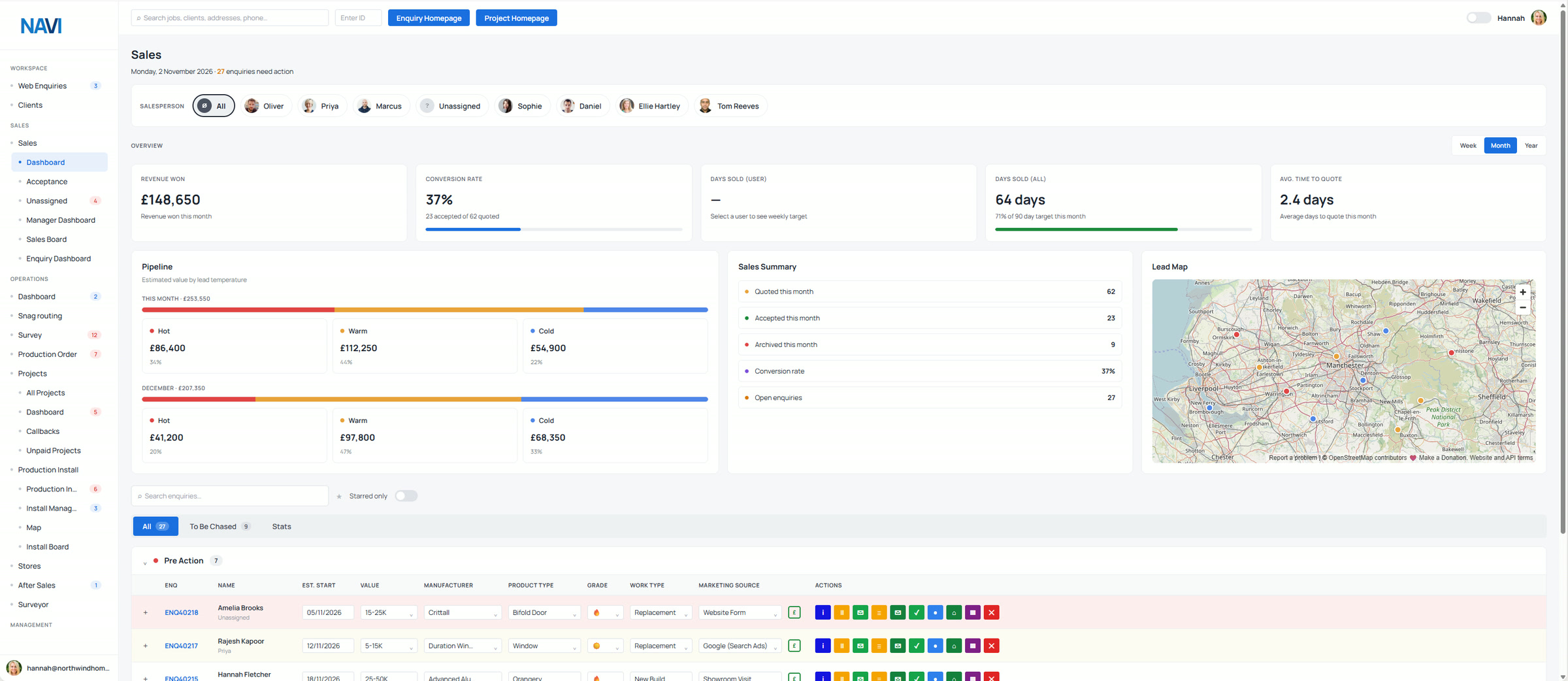
NAVI runs a windows and doors business end to end: enquiry, quote, survey, order, install and snags. The part nobody else builds is the part that understands what is actually being sold.
- Type
- Our own product
- For
- Window and door companies
- Built with
- John Knight (Glass) Ltd
- What we did
- Product design, development, window designer
- window and door types, across eight manufacturer systems
- 253
- screens, from first enquiry to final snag
- 74
- automated tests on the parts that cost money when they're wrong
- 910
The problem
A trade business is not a sales funnel.
Off-the-shelf CRMs model a pipeline: a lead becomes an opportunity, which becomes a deal. A windows and doors business has its deal in week one, and then eleven more things have to happen: a survey, an order priced against the manufacturer's own limits, a delivery to chase, a van and two fitters on a date, a sign-off, and the snags that come back afterwards.
None of that fits a pipeline, so it ends up in spreadsheets, WhatsApp and somebody's head. The information exists, but there's nowhere you can ask it a question.
The product has rules of its own, too. Every manufacturer publishes what their system can be made at, and those rules live in PDFs in a drawer. Not having them to hand costs more than a typo. It costs a frame that arrives on site and doesn't go in.
What we built
One system, from first enquiry to final snag.
Enquiry
Web and phone enquiries, graded and chased, with duplicate clients blocked at the door.
Quote
Priced frame by frame against the manufacturer’s own catalogue.
Acceptance
An eleven-step wizard that turns a quote into a job, with deposit terms.
Survey
Booked, chased and signed off, with each surveyor’s own worklist.
Order
Sent, delivery confirmed, cost confirmed and signed off, with every step audited.
Install
A booking board with fitters, capacity, and confirmed versus pencilled-in dates.
Snags
Parts ordered and chased, then routed to trips that are already being made.
The books
Order book, cash due, overruns, and work taken on but not kept.
Everything that changes a job writes an audit entry naming who did it and when. In a trade business, the question six months later is rarely “what does the system say?” and almost always “who agreed to that?”
The hard part
A window designer that refuses to draw the impossible.
At the centre of NAVI is a drawing tool that holds eight manufacturer systems as structured data rather than PDFs: profiles, sightlines, permitted combinations, glazing specifications and the size rules that govern them.
Draw a frame and it's measured in millimetres against the real profile. Pull it too wide and NAVI says so, in the manufacturer's own words, before anybody has ordered anything.
What it says when you draw the wrong thing
“Side hung sashes with 28mm 4/20/4 glazing: maximum 750 (800 with disclaimer) wide × 1500 (1550 with disclaimer) high.”
It knows “no” from “ask first”
A size past the limit blocks the save. A size inside the manufacturer's disclaimer range warns instead and lets it through. Those are different conversations, and a system that treats them the same gets ignored.
It gives the architect a drawing
Frames export as DXF at 1:1 in millimetres, with frame, sash, glass, opening direction and dimensions on separate layers. They open in AutoCAD at the right size, and an arched head comes across as a true arc.
It checks the maths twice
The geometry is checked in the browser as you draw, and again on the server before anything is saved. A drawing that passes on screen and fails in the factory is the expensive kind of bug.
Work that pays for itself
The questions the business couldn't ask before.
With jobs, dates, fitters and postcodes all in one place, NAVI can answer things nobody had the data for.
- Which open snags are within a few miles of an install that's already booked, so they can join a trip being made anyway.
- Which snags are close enough together to book as a single day.
- Which jobs are taking more days on site than were sold, costed at the rate each one was sold at.
- Which finished work is still unpaid, and which deposits are overdue.
Built to be trusted with the numbers.
Around 900 automated tests cover the parts where being wrong costs money: the manufacturing limits, the millimetre arithmetic, the deposit and payment logic, and who is allowed to see what.
- Built with
- .NET 9, Entity Framework Core, SQL Server
- Front end
- React 18, TypeScript, Ant Design
- Size
- 74 screens, 352 API endpoints
- Exports
- DXF drawings for AutoCAD
Generic software can record that a window was sold. NAVI knows how wide that window is allowed to be, which fitters are near it on Tuesday, what the architect needs to see, and who signed it off.